

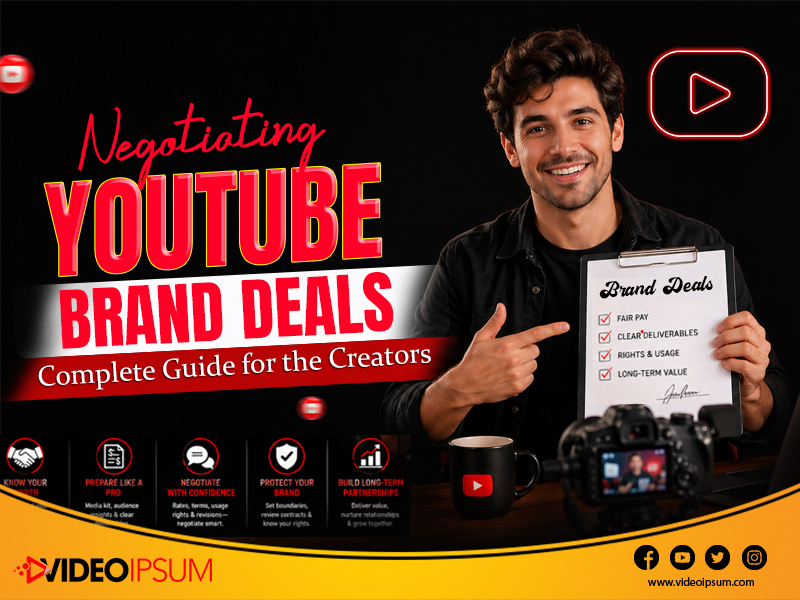
YouTube is not just a platform to upload
videos and gain views, but is also a profitable business model that allows
creators to monetize their videos. Getting a brand deal on YouTube is
definitely exciting, but getting paid what your content is actually worth is a
satisfying feeling altogether. Sponsorship can play a big role on YouTube and
help your channel, but accepting all the deals might not be a wise choice. It
requires knowing how to negotiate a brand deal properly that works in your
favor. The deal in this case is not just about money, but it also includes
revision limits, exclusivity windows, usage rights, payment terms, and
many other aspects. Let’s get through a complete guide for securing better
deals.
Do Your Thing before Conversation Takes
Place
Doing your homework is a must before you
jump into a deal. In 2025, more than 54% videos on YouTube were sponsored, and
that helped to gain around 19.1 billion views. This shows a significant boost
in numbers and showcases that a lot of creators are working with a lot of
brands. Before agreeing to a deal, you can check whether the brand is legit
enough through their existing creator partnerships. This can offer you a better
idea of what they are willing to pay.
You should also be aware of the metrics and
channel stats like average views per video, engagement rate, target
audience demographics, and others. It is recommended to work with the brands
from the niches of finance, B2B software, health, etc., that tend to pay more
for their valuable customers. You should also check what their campaign goal
is.
Let Your Brand Float the First Number
One of the oldest and wisest tricks in
negotiation is not to say the number first. While the brands might push you to
say a number, you can push them further by asking them what they are willing to
pay, and you can arrange some ground for agreement. Let the brand bring the
number first so that you do not have to lose room for negotiation. Besides, if
you say the number first, it makes you more needy, and you should stand strong
in your ground and listen to what the brand is expecting so that you can project
a budget accordingly.
Negotiation: Terms> Price
Did you know that exclusivity clauses and
usage rights can help you gain an additional 20–150% gain, offering the true
value of a deal? These factors or terms are more valuable than the price of the
project. As a negotiator, you must focus on the aspects of deliverables and
timeline, revision rounds, usage rights, and exclusivity. Addressing these
factors can help you get tunnel vision, and investments become secondary here.
Therefore, always negotiate based on the terms rather than the price.
Handling a Lowball Offer
On YouTube, there are various kinds of
creators and influencers. The brands are more likely to work with the creators
who belong to micro and mid-tier instead of the mega influencers, as they
tend to charge a lot. According to a report in 2025, 73% of the brands wanted
to collaborate with the micro and mid creators, and 80% of the brands increased
or maintained their budget for influencer or creator marketing, which seems to
be working in their favor. The brands are more likely to pay for online engagement,
and audiences trust that you gained through your channel, and the subscriber
count is not a big deal here.
You can also counter with value
justification, where you do not just ask for money but also showcase where the
invested money will be utilized. You can showcase the click-through rate of
your last campaign, and those outcomes can help to close better deals with
valid results. In case the brand is fixated on their budget and you are still
willing to take the deal, you can offer scope reduction instead. You can tell
them to meet their number with a small deliverable. But if nothing works, then
it is best to avoid the deal, as that brand is not focusing on the other metric
and long-term effects.
Red Flags in Deals
Even though creator marketing is one of the
most successful methods of marketing in the modern era and numerous brands are
leveraging it, more than 56% of the creators have claimed that brands pay them
very late. 74% of the mid and micro-tier creators on YouTube have stopped
working with the brands for this reason, and so, there is a significant drop in
collaboration in 2024. Although the numbers are increasing now, many of the
experience creators discovered that the contracts were never designed to protect
the creators in the first place, as the brands only focused on the profits.
Unlimited and unreasonable usage rights of
your video content can be considered a red flag in a deal that needs to be
avoided. Every deal or contract must come with an expiration and agreement
between both parties. There are also some contracts that allow a brand to
edit your video content or add a voiceover to it. This is even a greater
concern in this age of AI, where dubbing, AI-generated voice, and video models
are being spammed over every marketing approach. Similarly, you avoid the
contacts that offer performance-based payment based on clicks, views, or other
metrics. This PPC type model is more applicable for ad campaigns rather than
creator marketing.
Getting Paid: Structure and Protection
As mentioned already, payment is a big
issue for the creators as 90% of them have experienced it, and after facing
severe problems, around 41% creators had to improve their rates just to
sustain. The best way to close the deal would be a 50% upfront payment on
signing. You should further communicate and set a payment deadline in the
contract with transparency.
Final Thoughts
If you want to close more profitable deals
on YouTube in the coming days, it is recommended to hire a professional agency
like Videoipsum that specializes in promoting all kinds of videos. It
can be a reliable promotional partner that helps to reach the results that you
promised in the deal.
Popular Posts
April 22,2021
August 01,2020
December 15,2022
September 27,2023